A text guide to the presentation's argument and diagrams.
1. The Desert of the Real
A blueprint city and a photograph of the World Trade Centre introduce the question behind the presentation: how do we understand reality when trust in the people and systems describing it has fractured?
2. Two events, one cultural climate
The opening comparison places The Matrix (1999) beside the September 11 attacks (2001). The film's simulated realities, cyberpunk imagery and bullet-time effects are set against terrorism, surveillance and continuous global news coverage. The presentation argues that these different experiences helped shape a culture of suspicion and questioning of power.
3. Simulation enters mainstream culture
A diagram shows ideas passing from philosophy and science fiction, through The Matrix, into mainstream discussion. It references Plato's cave, Descartes' evil demon, Baudrillard's Simulacra and Simulation and later debates about the simulation hypothesis. Its central argument is that popular culture gave scepticism a shared vocabulary.
4. Fiction, trauma and perception
A circular diagram connects fiction as a primer, a traumatic event and the perception of anomalies. Neo's passport is presented as an example of the symbolic connections people draw between fiction and history. The slide introduces hyperstition: the idea of a fiction participating in the reality it describes.
5. Looking through the simulation lens
Two architectural drawings contrast consensus reality with a simulation lens. The slide uses World Trade Centre Building 7 to explore how events can be interpreted as signs of a hidden system when trust in official explanations has already eroded. This is the presentation's account of a way of interpreting events.
6. The red pill as a political metaphor
A red-pill diagram branches into cyber-libertarianism, the manosphere, and populist or anti-establishment movements. The slide examines how the language of awakening and rejecting mainstream narratives has travelled into different political and cultural settings.
7. From shared reality to competing realities
One large circle gives way to many smaller, separate circles. The diagram illustrates the presentation's argument that a shared factual baseline can fragment into insular realities. Social-media algorithms, deepfakes and institutional cynicism are offered as features of that landscape.
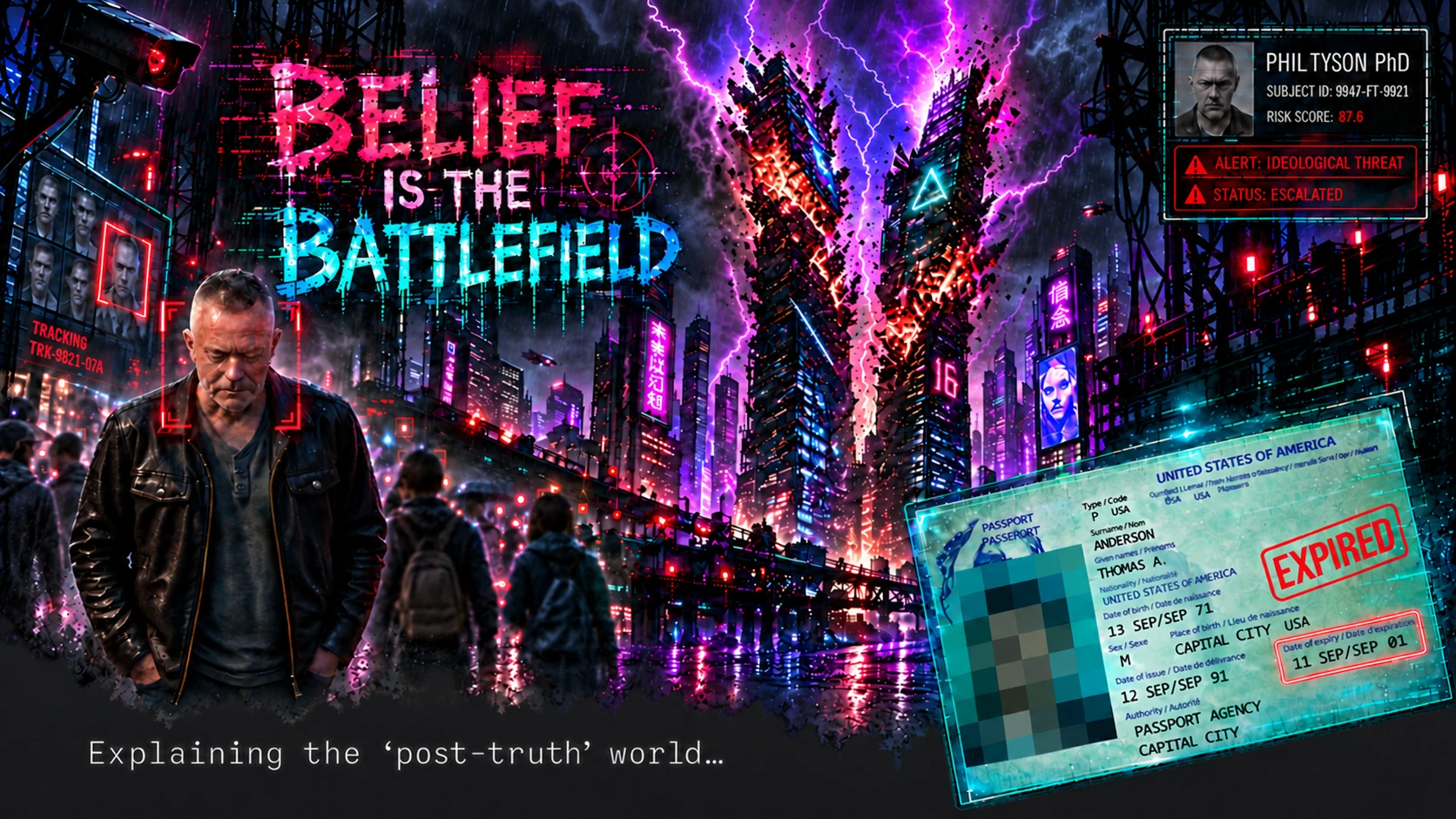
8. Belief as the battlefield
Arrows from algorithms, media consensus and political institutions point towards a human mind. The final slide frames attention and belief as contested territory and asks how people can move from passive observation towards greater agency in how they understand persuasion and create meaning.